German Citizenship Test practice test
Free German Citizenship Test practice for Germany: 122 questions with explanations, timed mock exams and progress tracking.
Start practising
Language note: the official test is in German. Questions here are in English to help you learn the content. Use the official material to learn the exact wording.
German Citizenship Test mock tests
3 fixed mock tests of 33 questions each, timed like the real test (pass mark 17 of 33 correct). Every question in the bank appears in exactly one mock, so working through all of them covers the whole bank.
About the German Citizenship Test
Last reviewed: October 19, 2026 · Checked against the official source linked on this page.
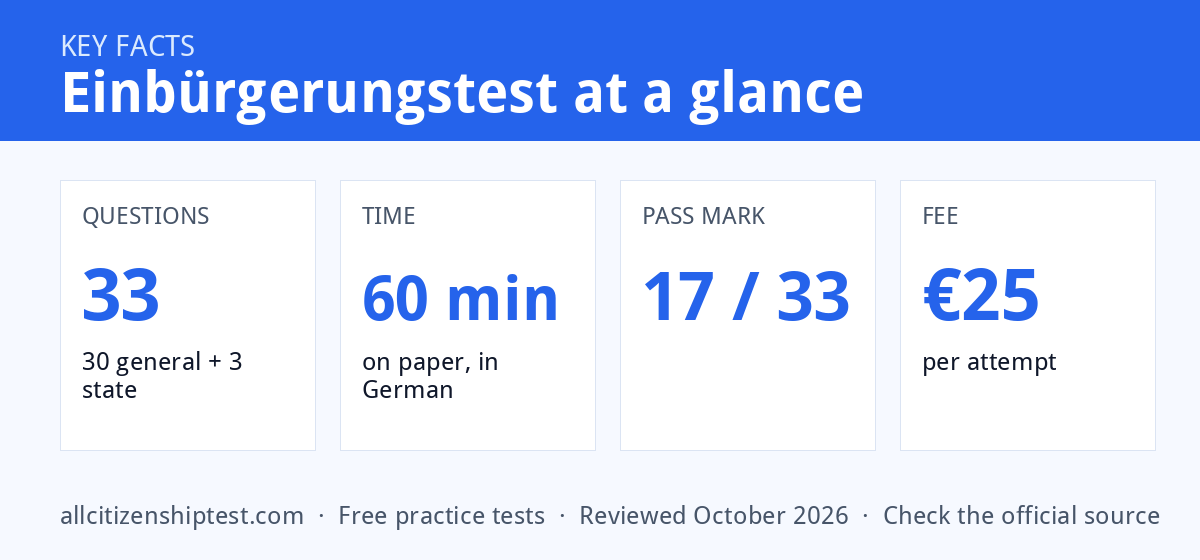
The Einbürgerungstest (naturalisation test) checks your knowledge of Germany’s democracy, history and society. It is required for most adults applying for German citizenship. The questions come from a public catalogue of 310 questions: 300 general questions plus 10 for each of the 16 federal states, of which the 10 for your own state apply to you.
The test has 33 questions: 30 general questions and 3 about the state where you live. You have 60 minutes and need 17 correct answers to pass. It costs 25 euros per attempt and is taken on paper, under supervision, at a test centre approved by the Federal Office for Migration and Refugees (BAMF), usually an adult education centre (Volkshochschule). The same question catalogue is used for the “Leben in Deutschland” test taken at the end of an integration course, and a pass in either one counts.
Who has to take it
Anyone aged 16 or over applying for naturalisation must show knowledge of the legal and social order and living conditions in Germany, and the test is the standard way to do that. You are exempt if you have a German school-leaving certificate (at least a Hauptschulabschluss) or a German degree in law, social sciences, politics or public administration, and if illness, disability or age prevents you from taking the test. There is no fixed age exemption; it is assessed case by case.
How the test day works
You register directly with a test centre; many run sessions monthly, so book early. Bring your passport or residence document. The test is a paper questionnaire in German with four answer options per question, and you mark one. You can leave early once you are done. Results are not given on the day: BAMF marks the papers and sends a certificate, typically within a few weeks, which you then submit with your naturalisation application. The certificate does not expire. If you do not pass, you can register again as often as you like, paying the fee each time.
What the questions cover
The catalogue has three themes. Living in a democracy is the largest: the Basic Law and fundamental rights, the Bundestag, Bundesrat, Federal President and Chancellor, elections, parties, the courts and federalism. History and responsibility covers the Weimar Republic, National Socialism and the Holocaust, the division and reunification of Germany, and Germany’s role in Europe. People and society covers religion, education, work, family, equality and everyday rules. The state questions ask about your state’s capital, coat of arms, parliament and head of government. Our questions and answers page follows the same themes.
Language
The real test is in German, at roughly B1 level of reading. Naturalisation also requires a separate German certificate at B1 or higher. This site shows the questions in English so you can learn the content first; once you know the facts, practise with the official German wording in BAMF’s online test centre so the vocabulary is familiar on the day.
How to study
- Work through practice mode by theme, starting with democracy, which supplies most of the 30 general questions.
- Learn the numbers and names: how many states, how long the Bundestag’s term is, who elects the Chancellor and the Federal President, the dates of 1933, 1945, 1949, 1961 and 1990.
- Study the 10 questions for your own state separately; they are easy marks.
- Take a timed mock exam until you pass three in a row with 25 or more, then clear your weak questions.
- Finish with the official German sample test so you recognise the wording.
Our questions are English versions of questions from the official BAMF catalogue. Always check BAMF’s online test centre, linked on this page, for the current German catalogue and your state’s questions.
| Official name | Einbürgerungstest (Leben in Deutschland) |
|---|---|
| Format | 33 multiple-choice questions on paper, under supervision |
| Language | German |
| Who takes it | Most adults applying for German citizenship. |
| Exemptions | You may be exempt if you have a German school-leaving certificate that covered politics or social studies, or if illness, disability or age prevents you from taking the test. |
Official test topics
- Living in a democracyThe Basic Law, the constitutional bodies, elections, the federal states and basic rights (Leben in der Demokratie).62 questions
- History and responsibilityThe Nazi period, the division of Germany, reunification and Europe (Geschichte und Verantwortung).35 questions
- People and societyFamily, education, religion, work and living together (Mensch und Gesellschaft).25 questions
Sample questions
Answer: The Basic Law (Grundgesetz). The Basic Law came into force on 23 May 1949.
Answer: Social market economy. Germany has a social market economy: supply and demand with state measures for social balance. [DE: Die Wirtschaftsform in Deutschland nennt man …]
Answer: With Germany's unconditional surrender. The Wehrmacht's unconditional surrender in May 1945 ended the war in Europe. [DE: Wie endete der Zweite Weltkrieg in Europa offiziell?]
How to prepare
Use the official BAMF online test centre to see the exact German wording of all questions.
Learn the 10 questions for your own federal state; 3 of them will be on your test.
Focus on key dates: 1949 (Basic Law), 9 November 1989 (fall of the Wall) and 3 October 1990 (reunification).
Learn the German terms for the main institutions: Bundestag, Bundesrat, Bundesverfassungsgericht.
Study guides for the German Citizenship Test
- Einbürgerungstest: The German Citizenship Test Explained – Germany's Einbürgerungstest has 33 questions, 60 minutes and a pass mark of 17. Learn the question catalogue, the…
- Which Citizenship Test Is the Hardest? All 15 Official Tests Ranked – Denmark and France have the hardest citizenship tests by the official rules (80% pass marks, values and scenario…
- Which Countries Have a Citizenship Test? A Country-by-Country Overview – About 20 countries run a formal citizenship test: the US, UK, Canada, Australia, Germany, France, Spain, Sweden, Greece…
- What Happens If You Fail a Citizenship Test? Retake Rules by Country – Failed your citizenship test? You can usually try again. Retake rules for the US, UK, Canada, Australia, Germany…
- Who Is Exempt from the Citizenship Test? Age and Medical Exemptions – Age and medical exemptions from citizenship tests in the US, UK, Canada, Australia, Germany and Spain: who does…
- Citizenship Test Pass Marks Compared: US, UK, Canada, Australia and More – Pass marks, question counts, time limits and languages for 15 official citizenship tests side by side: Denmark, France…
German Citizenship Test FAQ
How many questions are on the Einbürgerungstest?
33 questions: 30 from the general catalogue and 3 about your federal state.
What is the pass mark for the Einbürgerungstest?
You need 17 correct answers out of 33.
Is the Einbürgerungstest in German?
Yes. The official test is only in German. The English questions here help you understand the content; use the official catalogue to learn the German wording.
Are all the test questions published in Germany?
Yes. The full catalogue of 310 questions (300 general plus 10 per state) is public on the BAMF website.
Where can I practice the German citizenship test online?
Two free options. The official BAMF Online-Testcenter has all 310 questions in German: 300 general questions and 10 for each federal state. On this page you can practise 122 questions in English with explanations, take a timed mock exam in the official format (33 questions, 60 minutes, 17 to pass) and use 3 numbered mock tests.
Use ours to understand the content, and BAMF's to learn the exact German wording you will see on the day.
What questions are asked on the German naturalization test?
The Einbürgerungstest has 33 questions: 30 from the 300 general questions on three areas, "Leben in der Demokratie" (living in a democracy), "Geschichte und Verantwortung" (history and responsibility) and "Mensch und Gesellschaft" (people and society), plus 3 about your federal state.
Every possible question is published in the BAMF catalogue. You need 17 correct in 60 minutes, and the test is in German.