Canadian Citizenship Test practice test
Free Canadian Citizenship Test practice for Canada: 128 questions with explanations, timed mock exams and progress tracking.
Start practising
Canadian Citizenship Test mock tests
6 fixed mock tests of 20 questions each, timed like the real test (pass mark 15 of 20 correct). Every question in the bank appears in exactly one mock, so working through all of them covers the whole bank.
About the Canadian Citizenship Test
Last reviewed: October 19, 2026 · Checked against the official source linked on this page.
The Canadian citizenship test checks your knowledge of Canada’s history, geography, government, symbols, and the rights and responsibilities of citizens. Every question comes from the official study guide, Discover Canada: The Rights and Responsibilities of Citizenship, which Immigration, Refugees and Citizenship Canada (IRCC) provides free in print, online, as an ebook and as audio.
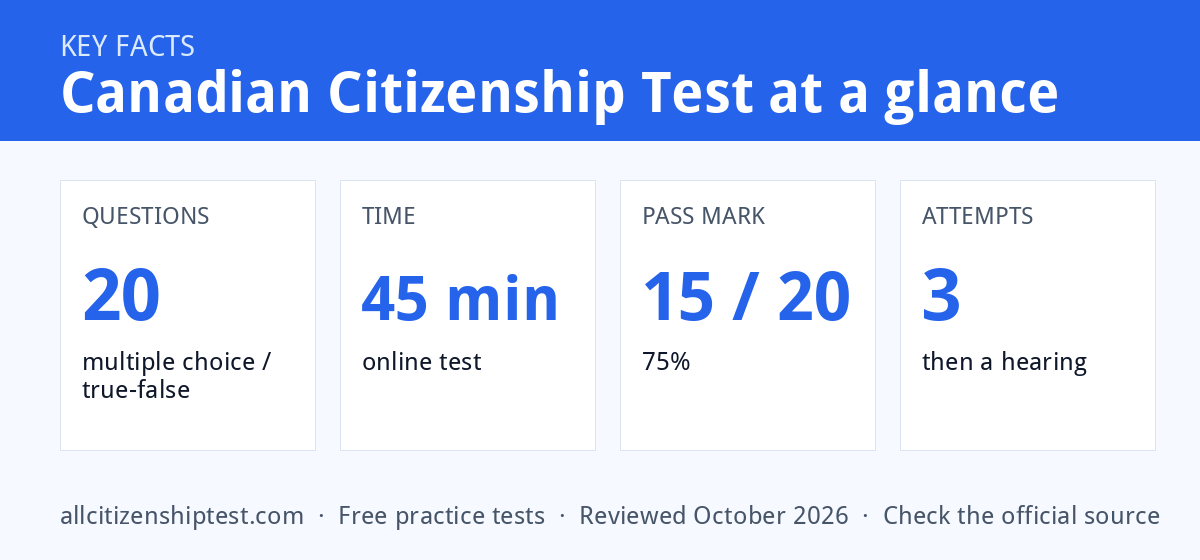
The test has 20 questions, a mix of multiple choice and true or false, and you need 15 correct answers (75%) to pass. Since IRCC’s updated instructions in March 2026, the self-administered online test is the default format, with 45 minutes allowed (the older written test gave 30 minutes). Questions are drawn from a large bank, so no two tests are the same. There is no separate fee; the test is part of your citizenship application.
Who has to take it
Applicants aged 18 to 54 on the day they sign their application take the test. Applicants under 18 or aged 55 and over do not. If you need an accommodation, for example extra time or an in-person sitting, you can ask for it; IRCC also uses in-person or video tests when there are identity-verification or technical problems, or at an officer’s discretion.
How the online test works
After IRCC processes your application, you receive an email invitation with a link and a deadline, usually a few weeks, within which to complete the test. You take it on your own computer or phone, with your camera on for identity checks, and your result appears on screen when you finish. An online pass is provisional until IRCC confirms your identity and reviews the session. You may then be invited to an interview with a citizenship officer, where your language ability, residence and other requirements can be checked.
What the questions cover
Discover Canada has eight main sections, and the test samples all of them: rights and responsibilities of citizenship; who we are (Indigenous peoples, the French and British heritage, and diversity); Canada’s history from early settlement to Confederation and the modern era; how Canadians govern themselves (federal, provincial and municipal government, the monarchy and Parliament); federal elections; the justice system; Canadian symbols; and Canada’s regions and economy. Our questions and answers page is grouped by these sections. History and government produce the most questions.
If you do not pass
Under the 2026 instructions you get three attempts at the written or online test. If you fail the third attempt, or an officer has doubts about your knowledge or language, you are invited to a hearing with a citizenship officer, who asks the questions orally. See our guide on retake rules by country.
Language
You can take the test in English or French. Applicants aged 18 to 54 must also prove language ability at Canadian Language Benchmark 4 or higher in speaking and listening, usually with an approved test result or evidence of education in English or French. The citizenship test itself is not a language test, but officers assess your language during any interview or hearing.
How to study
- Read Discover Canada all the way through once. It is about 60 pages; the audio version is useful while commuting.
- Use practice mode one section at a time and read every explanation. Pay attention to names, dates and “firsts”, which are common exact-answer questions.
- Learn the current office holders the guide refers to (the Governor General, the Prime Minister, your premier and your MP), and your province’s capital and symbols.
- Take a timed mock exam every few days until you pass three in a row with 17 or more, then clear your weak questions.
Our questions are written from Discover Canada in the style of the real test. The official question bank is not published, so use these alongside the guide. Check the IRCC page linked on this page for the current rules.
| Official name | Canadian Citizenship Test |
|---|---|
| Format | 20 multiple-choice and true-or-false questions; the self-administered online test is the default, with in-person or video tests in specific cases |
| Language | English or French |
| Who takes it | Citizenship applicants aged 18 to 54 on the day they sign their application. |
| Exemptions | Applicants under 18 or aged 55 and over do not take the test. |
Official test topics
- Rights and ResponsibilitiesThe Charter of Rights and Freedoms and the duties of citizens.12 questions
- Who We AreIndigenous peoples, official languages and Canada's diversity.13 questions
- Canada's HistoryFrom early exploration to Confederation and modern Canada.27 questions
- How Canadians Govern ThemselvesConstitutional monarchy, Parliament and federal, provincial and territorial government.18 questions
- Federal ElectionsHow MPs are elected and who can vote.12 questions
- The Justice SystemCourts, police and the law.10 questions
- Canadian SymbolsThe flag, the anthem, national symbols and holidays.16 questions
- Canada's RegionsProvinces, territories and their capitals.20 questions
Sample questions
Answer: Ottawa. Ottawa, in Ontario, was chosen as the capital by Queen Victoria in 1857.
Answer: Asia. Since the 1970s, most immigrants have come from Asian countries. Chinese languages are the second most spoken at home in Vancouver and Toronto after English.
Answer: The third Monday in October every four years. Federal elections must be held on the third Monday in October every four years following the most recent general election, although the Prime Minister may ask for an earlier election.
How to prepare
Read Discover Canada from start to finish at least once. Only its content appears on the test.
Make a list of all provinces, territories and their capitals.
Learn the key dates: 1867 (Confederation) and 1982 (the Charter of Rights and Freedoms).
Know which parts of government are elected and which are appointed.
Study guides for the Canadian Citizenship Test
- How Many Questions Are on the Canadian Citizenship Test? – 20 questions, 15 correct to pass, 45 minutes for the online test and three attempts before a hearing.…
- Canadian Citizenship Test: Questions, Pass Mark and How to Prepare – The Canadian citizenship test has 20 questions, a 30-minute limit and a pass mark of 15. Learn who…
- Citizenship Test Pass Marks Compared: US, UK, Canada, Australia and More – Pass marks, question counts, time limits and languages for 15 official citizenship tests side by side: Denmark, France…
- Is the Citizenship Test Multiple Choice? Format of Every Official Test – Most citizenship tests are multiple choice, but the US test is oral and Canada and Spain add true-or-false…
- Which Countries Have a Citizenship Test? A Country-by-Country Overview – About 20 countries run a formal citizenship test: the US, UK, Canada, Australia, Germany, France, Spain, Sweden, Greece…
- What Happens If You Fail a Citizenship Test? Retake Rules by Country – Failed your citizenship test? You can usually try again. Retake rules for the US, UK, Canada, Australia, Germany…
Canadian Citizenship Test FAQ
What is the pass mark for the Canadian citizenship test?
You need 15 correct answers out of 20 (75%).
Who has to take the Canadian citizenship test?
Applicants aged 18 to 54 on the date they sign their application.
What happens if I fail the Canadian citizenship test?
You are usually given a second test. If you fail again, you may be invited to an interview with a citizenship official, who can ask the questions in person.
What should I study for the Canadian citizenship test?
Study the free official guide, Discover Canada. All test questions are based on it.
Where can I take a free Canadian citizenship practice test?
On this page: 128 free practice questions based on Discover Canada, a timed mock exam in the official format (20 questions, 15 correct to pass), 6 numbered mock tests, flashcards and a weak-questions mode. No account needed.
IRCC publishes Discover Canada free as a PDF, eBook and audio at canada.ca.
What questions are asked on the Canadian citizenship test?
All questions come from Discover Canada. They cover the rights and responsibilities of citizens, who Canadians are (Indigenous peoples, English and French Canada), Canadian history, modern Canada, how Canada is governed (federal, provincial and local), elections, the justice system, national symbols, the economy and Canada's regions.
There are 20 multiple-choice or true-or-false questions, and you need 15 correct (75%). Some questions are about the province or territory where you live.
What is the best website to prepare for the Canadian citizenship test?
Start with IRCC's free study guide, Discover Canada; every question is based on it. Then check yourself with practice tests that use the official format: 20 questions, 15 to pass.
This page does that free, with explanations for every answer. For the format in detail, see how many questions are on the Canadian citizenship test.
Where can I find Canadian citizenship test questions and answers?
IRCC does not publish the real questions. Our Canadian citizenship test questions and answers page lists every practice question by Discover Canada chapter, with the answer and an explanation, and you can print it.
The flashcards on this page cover the same questions, if you prefer studying on your phone.
Is the Canadian citizenship test online?
Yes, for most applicants. Once IRCC invites you, you take the test online at home within the deadline in your invitation: 20 questions in 45 minutes, 15 correct to pass. Applicants aged 18 to 54 must take it. Follow the instructions in your invitation, because some people are scheduled for an in-person test or interview instead.