Short answer: The Einbürgerungstest is Germany’s citizenship test. It has 33 multiple-choice questions, taken on paper in German, and you have 60 minutes. You need 17 correct answers to pass. All questions come from a public catalogue of 310 questions: 300 general questions plus 10 about your federal state.
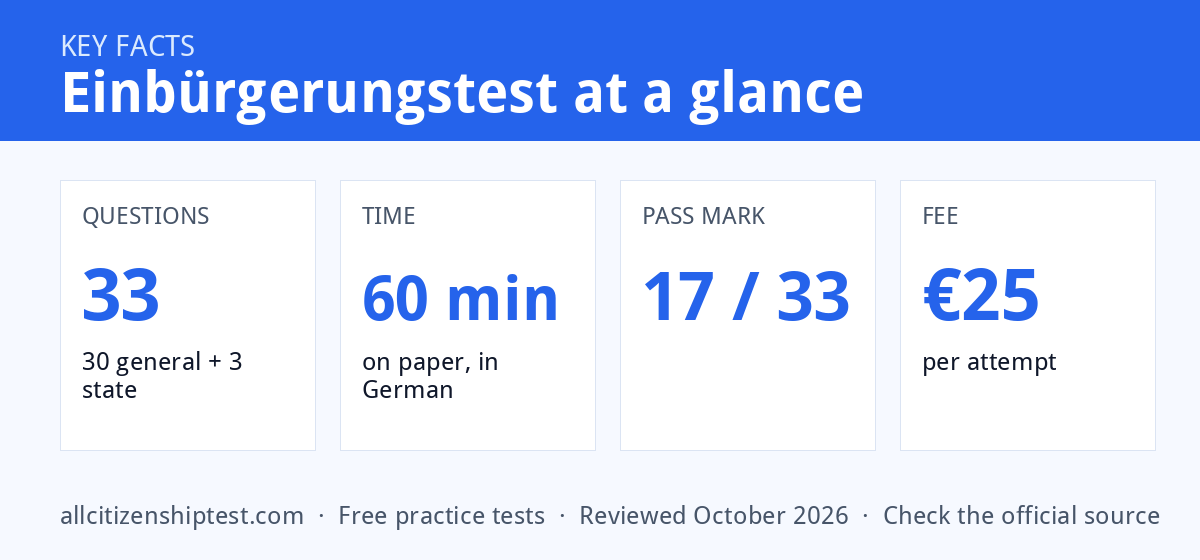
Einbürgerungstest at a glance
| Number of questions | 33 (30 general + 3 about your federal state) |
|---|---|
| Time allowed | 60 minutes |
| Pass mark | 17 correct answers |
| Format | Multiple choice with four options, on paper, under supervision |
| Language | German only |
| Question catalogue | 310 published questions per state (300 general + 10 state) |
| Run by | The Federal Office for Migration and Refugees (BAMF), with local test centres |
What is on the Einbürgerungstest?
The catalogue is organised into three broad areas:
- Living in a democracy: the Basic Law (Grundgesetz), fundamental rights, elections, parties, federalism and the rule of law.
- History and responsibility: National Socialism and its consequences, post-war division, the GDR, reunification and Germany in Europe.
- People and society: family, education, religious diversity, equality and everyday life.
Three of your 33 questions are about the federal state (Bundesland) you live in, such as its capital, coat of arms or state parliament.
Why the published catalogue is good news
Unlike many citizenship tests, every possible question is public. That means preparation is mostly about steady repetition. If you can answer all 310 questions for your state confidently, you will pass easily.
How to register for the Einbürgerungstest
Tests are held at approved test centres, often adult education centres (Volkshochschulen). You register directly with a test centre and pay the fee there. After the test, BAMF marks the paper and sends you the result and a certificate by post, which can take several weeks.
How to prepare for the German citizenship test
- Use the official catalogue on the BAMF online test centre to learn the exact German wording.
- Understand the content in your own language first. Our German citizenship practice test explains each answer in English, so you learn why, not just what.
- Learn your state’s 10 questions early. They are easy points and only ten to memorise.
- Repeat until every question feels automatic. Use our weak-questions mode to drill only the ones you miss.
- Do full 33-question mock exams in the final week.
Tip: Many wrong options in the catalogue sound plausible in German. Learn key words such as Bundestag, Bundesrat, Bundesverfassungsgericht and Grundgesetz, because questions often hinge on telling them apart.
Do I need German language skills too?
Yes. Naturalisation generally also requires German at level B1, proven with a recognised certificate such as the Deutsch-Test für Zuwanderer. The citizenship test and the language test are separate requirements.
Who is exempt?
You may be exempt if you have a German school-leaving certificate that covered politics or social studies, or if illness, disability or age prevents you from taking the test. Your naturalisation authority decides.
Fee, results and what the certificate is for
The Einbürgerungstest costs 25 euros per attempt, paid to the test centre when you register. You do not get the result on the day: BAMF marks the paper and sends a certificate by post, usually within a few weeks. The certificate does not expire, and you submit it with your naturalisation application. A pass in the “Leben in Deutschland” test, taken at the end of a BAMF integration course, counts in the same way because it uses the same question catalogue; you do not need both.
Who is exempt
You do not need the test if you have a German school-leaving certificate (at least a Hauptschulabschluss) or a German degree in law, social sciences, politics or public administration, or if illness, disability or age prevents you from taking it. There is no fixed age limit; the naturalisation authority decides case by case.
The test is not the language test
Naturalisation also requires a German language certificate at B1 or above, which is separate from the Einbürgerungstest. The test itself is written at roughly B1 reading level, so learning the content in English first and then practising the official German wording is the fastest route for most people. Our German citizenship questions and answers page is grouped by the three official themes; our citizenship test versus language test guide explains the difference.
Kurz zusammengefasst auf Deutsch
Der Einbürgerungstest („Leben in Deutschland“) besteht aus 33 Multiple-Choice-Fragen aus einem veröffentlichten Katalog von 310 Fragen (300 allgemeine und 10 zum jeweiligen Bundesland). Sie haben 60 Minuten Zeit und bestehen mit mindestens 17 richtigen Antworten. Die Gebühr beträgt 25 Euro; angemeldet wird bei einer Prüfstelle (meist Volkshochschule), das Ergebnis schickt das BAMF per Post. Der Test kann beliebig oft wiederholt werden. Befreit ist, wer einen deutschen Schulabschluss mit Politik- oder Sozialkundeunterricht hat oder wegen Krankheit, Behinderung oder Alter nicht teilnehmen kann. Auf dieser Seite üben Sie die Inhalte auf Englisch mit Erklärungen; die offiziellen Fragen auf Deutsch finden Sie im Online-Testcenter des BAMF.
Official sources
Start practising with our free Einbürgerungstest quiz.
Related guides
- Which Citizenship Test Is the Hardest? All 15 Official Tests Ranked – Denmark and France have the hardest citizenship tests by the official rules (80% pass marks, values…
- Which Countries Have a Citizenship Test? A Country-by-Country Overview – About 20 countries run a formal citizenship test: the US, UK, Canada, Australia, Germany, France, Spain,…
- Citizenship Test vs Language Test: What’s the Difference? – A citizenship test checks what you know about a country; a language test checks how well…
- How Long Does It Take to Study for a Citizenship Test? – Most people need 2 to 6 weeks of regular study to pass a citizenship test. Here…