Short answer: the Canadian citizenship test has 20 questions, multiple choice and true or false. You need 15 correct (75%) to pass. The online test, now the default, gives you 45 minutes; the older written test gave 30. You get three attempts before a hearing with a citizenship officer. There is no separate test fee.
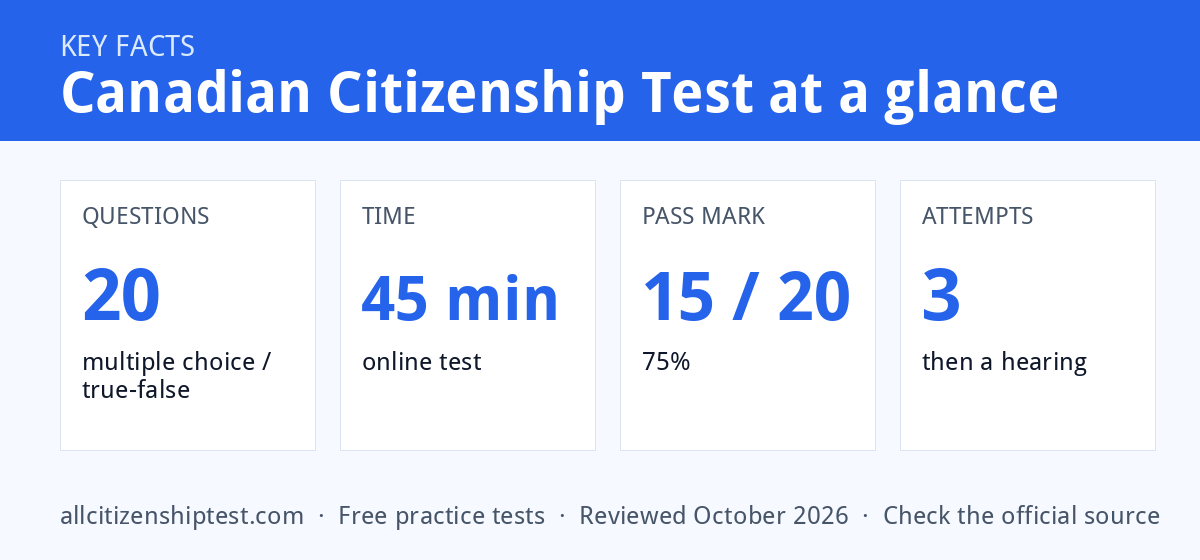
The numbers at a glance
| Questions | 20 (multiple choice and true/false) |
|---|---|
| Pass mark | 15 of 20 (75%) |
| Time | 45 minutes online (30 minutes for the written version) |
| Format | Self-administered online test by default; in person or by video in specific cases |
| Question bank | Drawn from a large bank based on Discover Canada; no two tests are identical |
| Who takes it | Applicants aged 18 to 54 on the day they sign the application |
| Attempts | 3, then a hearing with a citizenship officer (updated IRCC instructions, March 2026) |
| Fee | None beyond the citizenship application fee |
| Language | English or French |
What the 20 questions cover
Every question comes from the official study guide, Discover Canada: The Rights and Responsibilities of Citizenship. The test samples all of its sections: rights and responsibilities, who we are, Canada’s history, how Canadians govern themselves, federal elections, the justice system, Canadian symbols, and Canada’s regions. History and government produce the most questions. Our Canadian citizenship questions and answers page is grouped by these sections, and the Canadian citizenship practice test uses the real 20-question format.
How many can I get wrong?
Five. Fifteen correct out of 20 is the pass mark. Wrong answers are not penalised, so answer every question. In the online test your result appears on screen when you finish, but it is provisional until IRCC confirms your identity and reviews the session.
How does the online test work?
After IRCC processes your application you receive an email with a link and a deadline, usually a few weeks, within which to take the test on your own device with your camera on. If you need an accommodation, or there are technical or identity-verification problems, IRCC can arrange an in-person or video test instead. You may be invited to an interview afterwards, where an officer checks your language ability and the other requirements.
What if I fail?
Under IRCC’s March 2026 instructions you have three attempts. If you fail the third, or an officer has doubts about your knowledge or language, you are invited to a hearing where the questions are asked orally. Our guide on retake rules by country has the detail.
Is there a language test too?
Not a separate exam at the test stage, but applicants aged 18 to 54 must prove English or French at Canadian Language Benchmark 4 with their application, and officers assess your language at any interview or hearing.
Related guides
Canadian citizenship test: questions, pass mark and how to prepare · Pass marks compared · 30-day study plan
Official source
Immigration, Refugees and Citizenship Canada, Prepare for the citizenship test (canada.ca); IRCC operational instructions on the citizenship test, updated March 9, 2026.
Related guides
- Canadian Citizenship Test: Questions, Pass Mark and How to Prepare – The Canadian citizenship test has 20 questions, a 30-minute limit and a pass mark of 15.…
- Citizenship Test Pass Marks Compared: US, UK, Canada, Australia and More – Pass marks, question counts, time limits and languages for 15 official citizenship tests side by side:…
- Which Citizenship Test Is the Hardest? All 15 Official Tests Ranked – Denmark and France have the hardest citizenship tests by the official rules (80% pass marks, values…
- Which Countries Have a Citizenship Test? A Country-by-Country Overview – About 20 countries run a formal citizenship test: the US, UK, Canada, Australia, Germany, France, Spain,…