French Civic Exam practice test
Free French Civic Exam practice for France: 47 questions with explanations, timed mock exams and progress tracking.
Start practising
Language note: the official test is in French. Questions here are in English to help you learn the content. Use the official material to learn the exact wording.
About the French Civic Exam
Last reviewed: October 19, 2026 · Checked against the official source linked on this page.
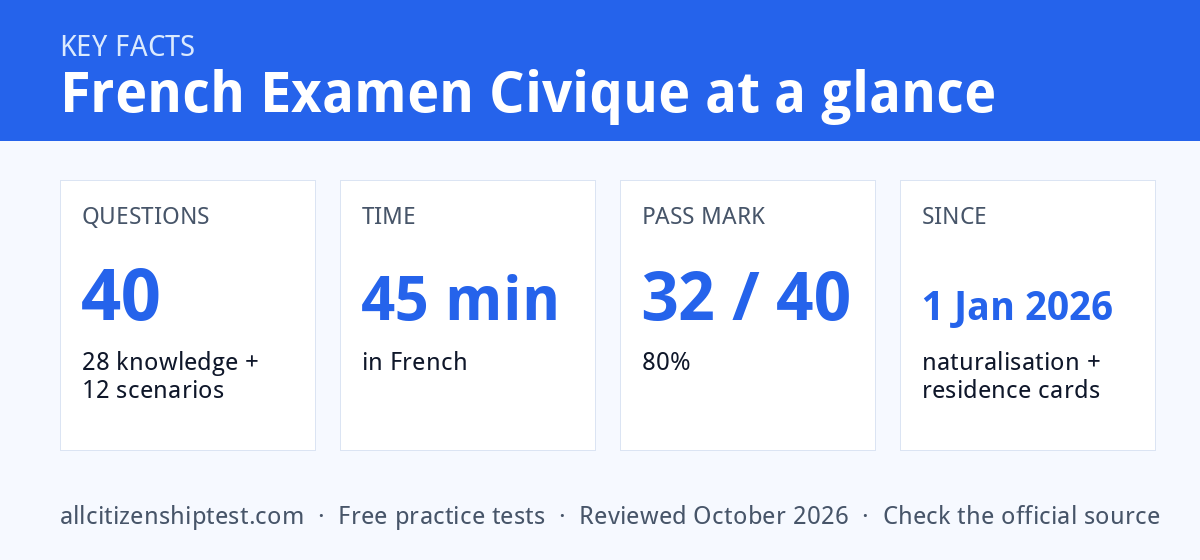
Since 1 January 2026, France requires a civic exam (examen civique) for naturalisation by decree and for the first issue of a multi-year residence card (carte de séjour pluriannuelle) or a 10-year resident card (carte de résident). It checks your knowledge of the Republic’s values, institutions, rights and duties, history, geography and culture, and daily life in France. The exam was created by Decree No. 2025-648 of 15 July 2025 and its programme is set by the Order of 10 October 2025.
The exam has 40 multiple-choice questions with four options each: 28 knowledge questions and 12 practical scenarios (questions de mise en situation). You have up to 45 minutes and need 32 correct answers (80%) to pass. It is taken on a computer at an accredited centre, in French. A pass certificate does not expire. The real exam is in French; this site shows the questions in English so you can learn the content first.
Who has to take it
Non-EU nationals applying from 1 January 2026 for a first multi-year residence card, a first resident card, or French nationality by decree (naturalisation) must pass the exam before they submit the application. Renewals of existing cards do not require it, and beneficiaries of international protection are among those not affected. Applicants for a multi-year card must also first complete the civic training course (formation civique) of 24 hours over four days organised by OFII. Check the official rules for your own permit, because the lists of affected and exempt permits are detailed.
How to register and sit the exam
Preparation sheets and the list of accredited exam centres are published on the Ministry of the Interior’s civic training site, formation-civique.interieur.gouv.fr. You register with a centre, pay any fee it charges, and sit the exam at a computer under supervision. If you do not pass, you can register again; there is no limit on attempts, but you must hold the certificate before your application can be filed, so leave time for a second sitting.
What the questions cover
The programme has five themes. Principles and values of the Republic: liberty, equality, fraternity, secularism (laïcité), equality between women and men. The institutional and political system: the Constitution of the Fifth Republic, the President, Government, Parliament, local authorities and the European Union. Fundamental rights and duties: the rights guaranteed by the Constitution, duties such as paying tax and respecting the law, and the justice system. History, geography and culture: key dates from the Revolution to today, the regions, symbols such as the flag, anthem and Marianne, and cultural heritage. Daily life in France: health, work, housing, school, administrative procedures and everyday rules; the 12 scenario questions mostly come from here. Our questions and answers page follows these themes.
Language
The exam is in French and the questions assume you can read everyday French. Naturalisation and the resident card also require a separate French language certificate; the exam does not replace it. Learn the content in English here, then study the official preparation sheets in French so the vocabulary is familiar.
How to study
- Work through the five themes in practice mode. The values and institutions themes supply most of the knowledge questions.
- Learn the key dates and numbers: 1789, 1905, 1944 and 1958; the length of the President’s term; the two chambers of Parliament; the number of regions.
- For scenario questions, think about what a resident is expected to do: declare income, register a child at school, use the public health system, respect secularism in public services.
- Take a timed mock exam until you pass three in a row with 34 or more, then clear your weak questions.
Our guide to France’s new civic exam has more on who is affected. Always check Service-Public.fr and the Ministry of the Interior site, linked on this page, for the current rules.
| Official name | Examen civique |
|---|---|
| Format | 40 multiple-choice questions on a computer at an approved centre |
| Language | French |
| Who takes it | Applicants for French nationality by decree, and applicants for a first multi-year residence card or 10-year resident card. |
| Exemptions | Some renewals and some nationalities covered by international agreements are exempt. Check the official rules for your situation. |
Official test topics
- Principles and values of the RepublicThe motto, secularism (laïcité), symbols and equality.11 questions
- Institutional and political systemThe President, Parliament, government and local authorities.10 questions
- Rights and dutiesFundamental freedoms, voting and the duties of residents.9 questions
- History, geography and cultureKey dates, French territory and cultural heritage.11 questions
- Living in French societyEducation, health, work and everyday life.6 questions
Sample questions
Answer: Liberté, Égalité, Fraternité. The motto appears on public buildings across France.
Answer: Indivisible, secular, democratic and social. Article 1 of the Constitution states: "La France est une République indivisible, laïque, démocratique et sociale."
Answer: It is always universal, equal and secret. Article 3 states that suffrage "est toujours universel, égal et secret". Voting is a civic duty in France, but it is not compulsory.
How to prepare
Check which level of exam applies to you: the content for naturalisation is more demanding than for a residence card.
Learn the scenario style: 12 of the 40 questions describe a real-life situation.
Revise the founding texts: the 1789 Declaration of the Rights of Man and the 1958 Constitution.
Practise in French as well, because the official exam is only in French.
Study guides for the French Civic Exam
- France’s New Civic Exam (Examen Civique): A 2026 Guide – Since January 2026, a 40-question civic exam is required for French naturalisation and for multi-year and 10-year residence…
- Which Citizenship Test Is the Hardest? All 15 Official Tests Ranked – Denmark and France have the hardest citizenship tests by the official rules (80% pass marks, values and scenario…
- Which Countries Have a Citizenship Test? A Country-by-Country Overview – About 20 countries run a formal citizenship test: the US, UK, Canada, Australia, Germany, France, Spain, Sweden, Greece…
- Citizenship Test Pass Marks Compared: US, UK, Canada, Australia and More – Pass marks, question counts, time limits and languages for 15 official citizenship tests side by side: Denmark, France…
- Citizenship Test Changes in 2025 and 2026: What’s New – Recent citizenship test changes: the 2025 US civics test, France's mandatory civic exam, Germany's 2024 reform, and new…
French Civic Exam FAQ
When did the French civic exam become mandatory?
On 1 January 2026, under the immigration law of 26 January 2024.
What is the pass mark for the examen civique?
You need 32 correct answers out of 40 (80%).
Who has to take the French civic exam?
Applicants for naturalisation by decree, and applicants for a first multi-year residence card or 10-year resident card, unless an exemption applies.
Is the examen civique the same as the French language test?
No. The civic exam tests knowledge of France. You must also prove your French level separately with an approved language test.
Where can I take a free French civic exam practice test?
On this page: 47 free practice questions on the official themes of the examen civique, in English with explanations, and a timed mock exam in the real format (40 multiple-choice questions, 32 correct to pass, 45 minutes).
The Ministry of the Interior's civic training site (formation-civique.interieur.gouv.fr) publishes the official themes and study material in French. The real exam is in French, so study the French wording there too.