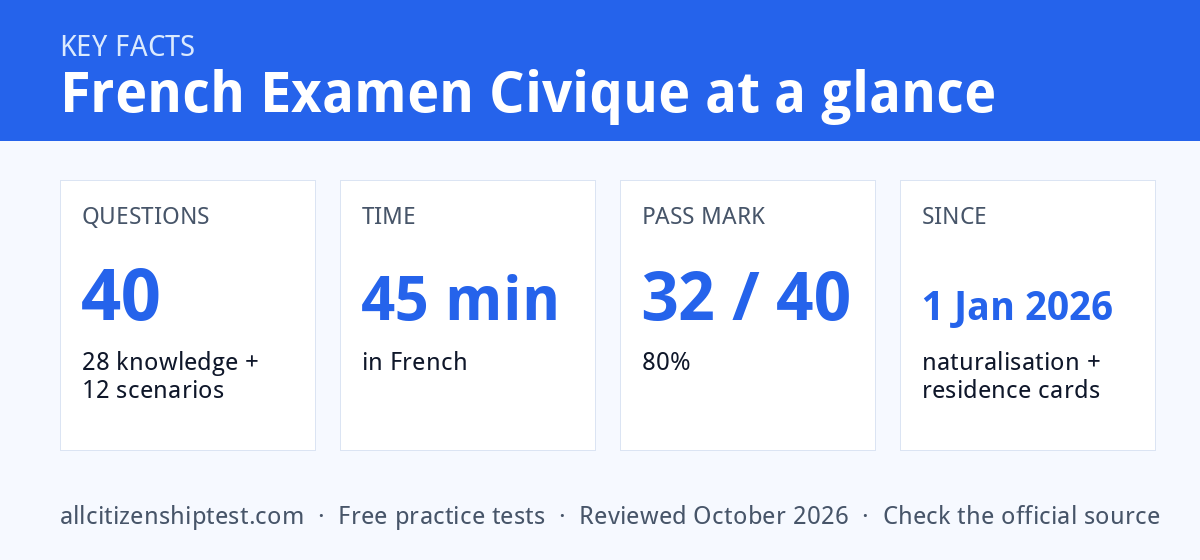
Short answer: since 1 January 2026, France requires a 40-question civic exam (examen civique) before you can apply for naturalisation by decree, a first multi-year residence card or a first 10-year resident card. You have 45 minutes and need 32 correct answers (80%). It is taken in French, on a computer, at an accredited centre, and a pass never expires.
Where the exam comes from
The immigration law of 26 January 2024 created the exam. Decree No. 2025-648 of 15 July 2025 set out how it works, and the Order (arrêté) of 10 October 2025 fixed the programme, the tests and how it is organised. It applies to applications submitted from 1 January 2026.
Who has to take it?
- Applicants for French nationality by naturalisation or reintegration by decree.
- Applicants for a first multi-year residence card (carte de séjour pluriannuelle).
- Applicants for a first 10-year resident card (carte de résident).
Renewals of cards you already hold do not require the exam. Beneficiaries of international protection (refugees and people with subsidiary protection) are among those not affected, and some nationalities covered by bilateral agreements have their own rules. Applicants for a multi-year card must first complete the 24-hour civic training course (formation civique) run by OFII over four days; the exam comes after it.
What is the format?
The exam is taken on a computer at an accredited centre. It has 40 multiple-choice questions with four options each: 28 knowledge questions and 12 practical scenario questions (mises en situation) that describe an everyday situation and ask what a resident should do. You have up to 45 minutes and need 32 correct answers (80%) to pass. The pass mark is high compared with most citizenship tests, so you cannot rely on one strong theme carrying weaker ones.
What does it cover?
- Principles and values of the Republic: liberty, equality, fraternity, secularism (laïcité), equality between women and men, and the republican motto and symbols.
- The institutional and political system: the Constitution of 1958, the President, Prime Minister and Government, the National Assembly and Senate, local authorities and France’s place in the European Union.
- Rights and duties: the freedoms the Constitution guarantees, the duties of residents (respecting the law, paying taxes, school attendance for children) and how justice works.
- History, geography and culture: key dates and figures from the Revolution to the Fifth Republic, the regions and overseas territories, and cultural heritage.
- Living in French society: health, work, housing, school, public services and administrative procedures. Most scenario questions come from here.
How to register, and what it costs
The Ministry of the Interior’s site, formation-civique.interieur.gouv.fr, publishes preparation sheets for each theme and the list of accredited exam centres. You register with a centre and sit the exam under supervision. Any fee is set at centre level; check when you book. If you do not pass, you can register again, but you must hold the certificate before you file your application, so allow time for a second attempt.
The exam is not the language test
The civic exam checks knowledge, not French ability. Naturalisation and the resident card still require a separate French language certificate at the level set for your route, which rose under the 2024 law. You need both. Our guide to citizenship tests versus language tests explains the difference.
How to prepare
Start with the official preparation sheets, then use our French civic exam practice test to learn the content in English, theme by theme. Once the facts are solid, go back to the French sheets so the vocabulary is familiar, and take timed 40-question mock exams until you score 34 or more consistently. Always check Service-Public.fr and the Ministry of the Interior site for the latest rules, because the exam is new and details may be refined.
En résumé, en français
L’examen civique est obligatoire depuis le 1er janvier 2026 pour la naturalisation par décret et pour certaines cartes de séjour (première carte pluriannuelle et carte de résident de 10 ans). Il comporte 40 questions à choix multiple sur ordinateur, passées dans un centre agréé, en 45 minutes ; il faut 32 bonnes réponses pour réussir. Les thèmes sont les valeurs et principes de la République, les institutions, l’histoire, la géographie et les droits et devoirs ; le programme officiel est publié sur formation-civique.interieur.gouv.fr. Certaines nationalités couvertes par des accords internationaux et certains renouvellements sont dispensés. Cette page présente les notions en anglais avec des explications ; révisez aussi le programme officiel en français.
Official sources
Service-Public.fr, A new civic examination for foreigners wishing to settle in France (18 December 2025); Decree No. 2025-648 of 15 July 2025; Order of 10 October 2025; formation-civique.interieur.gouv.fr.
Related guides
- Is the Citizenship Test Multiple Choice? Format of Every Official Test – Most citizenship tests are multiple choice, but the US test is oral and Canada and Spain…
- Which Citizenship Test Is the Hardest? All 15 Official Tests Ranked – Denmark and France have the hardest citizenship tests by the official rules (80% pass marks, values…
- How to Prepare for a Citizenship Test: A Step-by-Step Plan – A practical six-step plan to go from your first look at the official guide to test…
- How to Study Citizenship Questions So You Actually Remember Them – Spaced repetition, testing yourself and learning the reason behind each answer. Simple techniques that make facts…